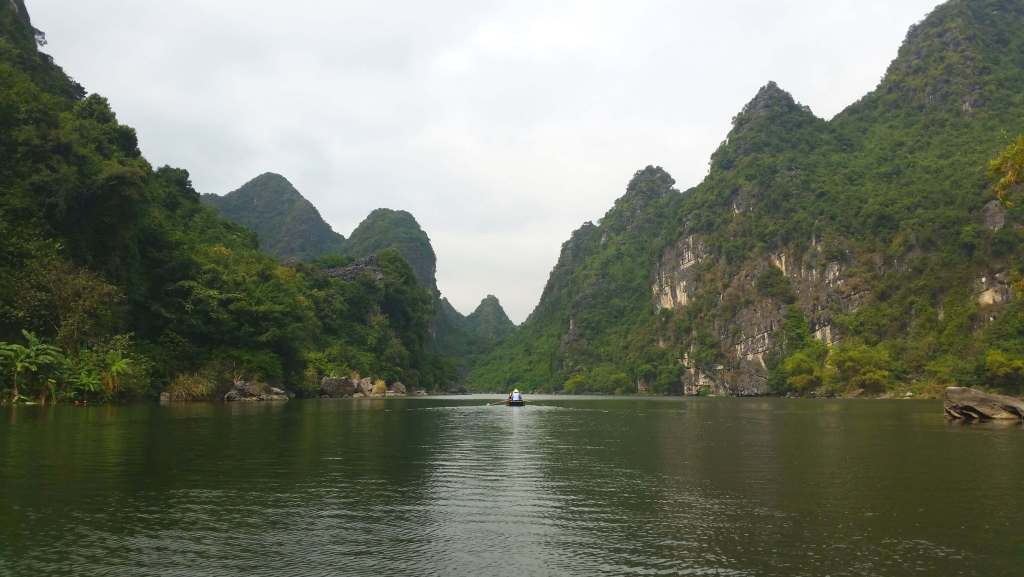
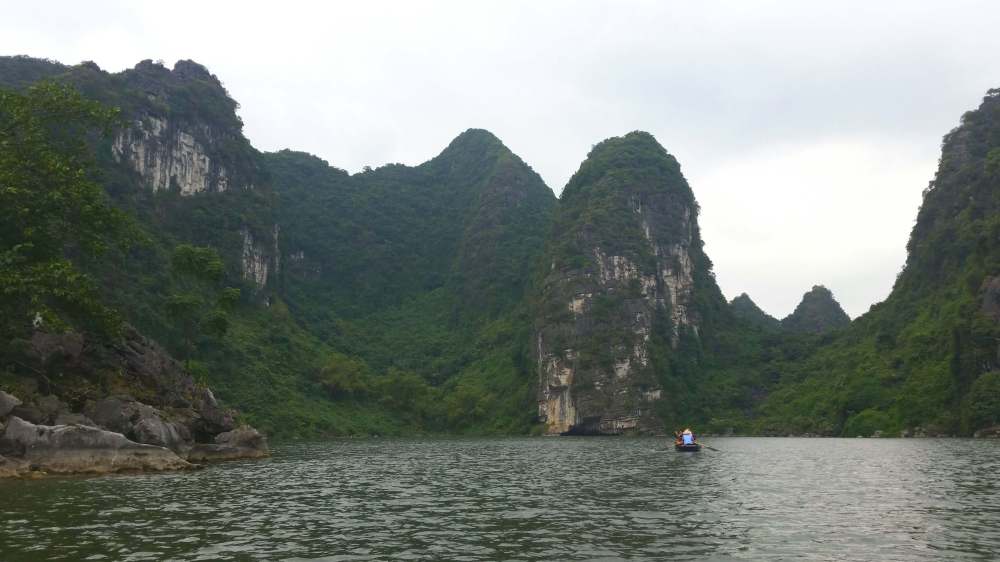
Trang An (pronounced Chahng-Ahn), is a stunning area of calm emerald waters, where temples and pagodas are tucked away behind dramatic limestone karsts. In 2014, it was designated a UNESCO World Heritage Site for its outstanding natural beauty and cultural significance.
Like Halong Bay, Trang an is best explored by water. Boats glide along peaceful waterways, winding past limestone cliffs, caves, and hidden temples. At the docks, you’ll find hundreds of small wooden rowboats ready for visitors. There are now four routes to choose from, each offering a slightly different perspective of the valleys, caves, and cultural sites. The rowers have remarkable control, never hitting the cave walls despite them being so narrow and always pointing out when you need to duck. Beyond the caves, the space opens into hidden coves where temples and pagodas are nestled on small islands. Your boat will stop, allowing you roughly 15-30 minutes to explore each temple by yourself. Walk up stone steps to fabulous views of towering limestone, glistening green waters and lush tropical plants.
Choosing a route
Route 1: 9 caves, 3 temples
Covering 12–15 km in about 3 hours, this is the longest of the Trang An routes and the best choice for cave enthusiasts. It offers the most extensive underground journey with nine caves to explore, each revealing unique geological formations: Toi (Dark Cave), Sang (Bright Cave), Nau Ruou (Wine Cooking Cave), where it is said kings once brewed wine from underground waters, Ba Giot (Three Drips Cave), Seo (Dry Cave), Son Duong (Mountain Spirit Cave), as well as Khong, Tran, and Quy Hau caves. You’ll also explore three temples: Trinh Temple, dedicated to the Trinh Lords who ruled Vietnam in the 17th and 18th centuries; Tran Temple, a spiritual site linked to the Tran Dynasty and regarded as the heart of Trang An’s heritage; and Khong Temple, honouring the famed Chinese strategist Zhuge Liang, also known as Kongming.
Route 2: 4 caves, 3 temples
This is the one of the shorter routes, taking around 2 hours — ideal if you’re short on time. You’ll pass through several hidden caves before reaching Hanh Cung Vu Lam (Vu Lam Royal Steps), a 13th-century complex of temples, shrines, and palaces built by the Tran Dynasty as both a royal refuge and a place of worship. The route also includes Cao Son Temple and Suoi Tien Temple, dedicated to Quy Minh Dai Vuong, the water deity believed to bring prosperity to the land.
Route 3: 3 caves, 3 temples
This 6 km route lasts around 3 hours and is best known for featuring Trang An’s longest cave! Dot Cave stretches 1 km and takes about 30 minutes to paddle through. You will also navigate through Van and Dai caves, each showcasing distinctive rock formations. Cultural highlights include Trinh Temple, Suoi Tien Temple, and the Vu Lam Royal Steps. The journey also passes through quieter, less-visited caves, and includes a stop at Khe Coc Island (formerly the Skull Island film set from Kong: Skull Island).
The Phoenix Route: 4 caves, 2 temples
As the newest option, this route is ideal for those who have visited Trang An before and want to discover something new. It’s also the shortest, taking around 1.5 hours. You’ll explore highlights including; Thanh Cao Son Temple, Thanh Truot Cave, Dai Cave, and the historic Vu Lam Royal Steps.
Planning your visit
When to visit
Open every day 7 am – 4 pm. Arriving early is the best way to beat the crowds. The mornings are cooler, and the soft light creates the perfect conditions for stunning photos without the glare of the afternoon sun.
Spring Autumn tend to be the most pleasant times to visit when the weather is cooler. Summer can be very hot, and as there is little shade (expect when you’re in the caves) you’ll want to arrive early. Winter may bring foggy views – great for atmospheric photos.
Cost
Tickets can be purchased at the entrance gate. The price is fixed for all routes at 250,000 VND per person or 1,000,000 VND if you want the boat to yourself.
Boats accommodate four passengers so, if your group is smaller, you’ll need to wait for additional passengers or pay for the extra seats to have the boat to yourself.
Tipping
While tips aren’t mandatory, I highly recommend showing appreciation for your hard-working rower. Hand a tip of 50,000–100,000 VND in cash directly them at the end of your trip.
Final tips for your visit
What to take
Pack a hat, sunglasses, and an umbrella to protect yourself from strong sun or sudden rain.
Dress modestly
Cover your shoulders and knees to show respect when visiting temples. Plus covering up will shield you from the sun reflecting off the water, avoiding nasty sunburn.
Always wear your life jacket
Obviously, it’s provided for your safety.
Note your boat number
Before rushing off to explore the temples, take a quick moment to remember your boat number; it’ll make finding your boat again much easier.
 Little Amy Tours
One Comment Add yours